Record Numbers of Chicks Take to the Skies
Key takeaways
- At least 73 young Hen Harriers fledged across RSPB reserves in Wales, Cumbria and the Forest of Bowland in 2026.
- RSPB Geltsdale had its best year in over a century, with 13 chicks from three nests.
- Lake Vyrnwy holds less than 1% of Wales’s suitable habitat but more than a fifth of the Welsh population used it this season.
- Young Hen Harriers still face serious danger after leaving the nest, mainly from illegal persecution.
The 2026 breeding season has given us some of the best Hen Harrier news in years. After a hard twelve months for our satellite tagged birds, reserve teams, volunteers and landowners across Wales and northern England are reporting strong, and in places record-breaking, numbers of chicks leaving the nest.
This post brings together the results published so far, explains what made these sites work, and looks at what happens next for this year’s young birds. If you’re new to the species, our guide to the Hen Harrier covers how to identify one, where they live and why they’re so rare.
Hen Harrier breeding in 2026 at a glance
- RSPB Geltsdale, Cumbria: 13 chicks
- RSPB Lake Vyrnwy, Powys: 17 chicks
- RSPB Tanrallt, Powys: 4 chicks
- RSPB Carngafallt, Powys: 3 chicks
- Forest of Bowland, United Utilities Estate: 30 chicks
- Forest of Bowland, private estates: 6 chicks
Total: at least 73 chicks fledged
Natural England publishes the national figures for England in the autumn, which will give us new data we can bring into this review. For context, Natural England’s 2025 figures recorded 39 breeding attempts in England, 33 of them successful, fledging 106 chicks.

RSPB Geltsdale: the best year in over a century
In Cumbria, thirteen chicks fledged from three nests at RSPB Geltsdale in the north Pennines, the most the reserve has recorded in more than a century and well up on its previous best of eight in 2024, according to the RSPB’s Geltsdale announcement.
The result came from hard, patient work. Staff set up diversionary feeding stations licensed by Natural England, a well-established way of reducing the chance of the adults preying on grouse on neighbouring shooting estates while they feed their young, and monitored the nests day and night to keep disturbance to a minimum. Several chicks have already been tagged so their movements can be followed after they leave the reserve.
Hen Harriers in Wales: a stronghold at Lake Vyrnwy
Wales has had an excellent summer. As RSPB Cymru reports, six territories were set up at RSPB Lake Vyrnwy this spring and five nests fledged 17 young, while four more chicks fledged at nearby RSPB Tanrallt, making 21 across the two sites.
Vyrnwy punches well above its weight with the reserve making up less than 1% of the potentially suitable breeding habitat in Wales, yet more than 20% of the estimated Welsh population used it during the breeding season. Further south, three chicks fledged at RSPB Carngafallt, bringing the reserve’s total to 19 since 2022.
Forest of Bowland: steady success, and a farewell
Bowland in Lancashire has come a long way. Hen Harriers were completely absent as a breeding species there in 2016 and 2017, and over the last six years the population has settled at an average of 13 breeding females, according to the RSPB’s Bowland update.
This year, breeding numbers were lower than the record 2025 season but success was higher, probably thanks to more prey. RSPB staff and volunteers monitored nine nests on the United Utilities Estate, eight of which fledged 30 young. Natural England also recorded two successful nests on private estates, fledging six more chicks.
There was one sad note. Bowland’s oldest and most productive female, nicknamed Scottish Fury, didn’t return this year and most likely died over the winter. She fledged on Langholm Moor in 2017 and raised an extraordinary 35 chicks over eight seasons, with some of her descendants now nesting in Bowland too. Langholm Moor is where the community-owned Tarras Valley Nature Reserve now sits, a place close to our hearts and home to several of the birds our supporters have tagged over the years.
Why these sites are working
If we look at where the good news comes from we can see a pattern as these are places where Hen Harriers are wanted.
Hen Harriers nest on the ground among heather and other tall vegetation in open uplands, and managing a mosaic of upland habitats gives them both safe nesting spots and the feeding areas they need to raise young.
Add supportive landowners, round the clock nest watches and in some places diversionary feeding, and the birds do the rest.
It’s a clear reminder of what our uplands could look like if Hen Harriers were simply left alone to breed; which is sadly not often the case.
The danger after fledging: Hen Harrier persecution
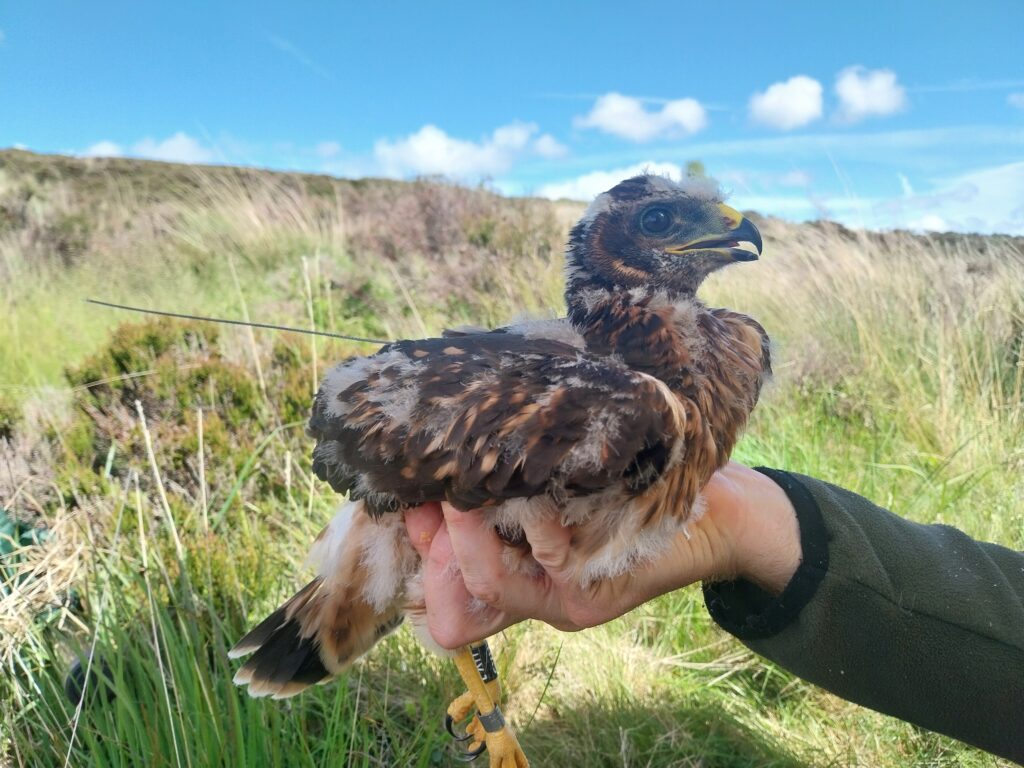
Whilst we celebrate the success of our fledged chicks, leaving the nest is where the hardest part of a Hen Harrier’s life begins. Research from the world’s largest GPS tracking study of the species found that young tagged birds lived an average of just 121 days after fledging, with illegal killing highest in areas managed for grouse shooting.
The BTO’s summary of the evidence is plain: illegal killing has been identified as the biggest single factor affecting the species, with a dramatic impact on populations in core areas of northern England and Scotland.
This summer also brought a stark reminder from Wales. In July, the RSPB reported that a young tagged Hen Harrier from the Peak District had survived just three days on Ruabon Moor before vanishing in highly suspicious circumstances, in an area the charity describes as one of the UK’s most notorious persecution hotspots.
There has been some progress on justice: in January 2026 a gamekeeper on a grouse shooting estate in Yorkshire became the first person convicted of Hen Harrier persecution in England, only the third conviction in the UK in 25 years.
So this year’s chicks deserve celebrating, and they also deserve safe passage through the months ahead. It’s why we campaign against raptor persecution.
How Hen Harrier Action supporters are helping
Thanks to our supporters’ generosity in last winter’s Christmas Appeal, four satellite tags were fitted to young Hen Harriers this summer by licensed RSPB taggers and local raptor study groups. We’ll share their journeys over the coming months.
Tags do two jobs. They teach us how young harriers use the landscape, and they make crimes against them much harder to hide. DI Mark Harrison of the National Wildlife Crime Unit told our Skydancer Day audience that the NWCU has analysed 152 “sudden stop, no malfunction” tag incidents since 2021, identifying eight hotspots, seven of them on driven grouse moors. Watch the full interviews in our Skydancer Day 2026 roundup.
Your donations also fund wildlife crime detection dogs working with the NWCU. See the latest detection dog update to find out where they’ve been deployed.
How you can help Hen Harriers
- Share the good news. Every person who hears about Hen Harriers is one more person who’ll notice if they go missing.
- Be eyes and ears in the uplands. If you see something suspicious, call the police on 101 and mention wildlife crime.
- Follow this year’s tagged birds by signing up to our newsletter.
- Get involved through our events, appeals and Young Wild competitions on our Get Involved page.
Frequently asked questions
How many Hen Harrier chicks fledged in 2026?
At least 73 chicks fledged across RSPB Geltsdale, the Forest of Bowland and three RSPB reserves in Wales. National figures for England are usually published by Natural England in the autumn, and Scotland holds most of the UK population.
Where did Hen Harriers breed most successfully in 2026?
The Forest of Bowland in Lancashire produced the most chicks (36 across 10 successful nests), while RSPB Geltsdale in Cumbria had its best year in over a century and RSPB Lake Vyrnwy became a stronghold for the Welsh population.
What is diversionary feeding?
It’s a licensed technique where food is left near a Hen Harrier nest so the adults have less need to hunt over neighbouring land. It was included in Natural England’s 2016 Hen Harrier Action Plan as one way of easing conflict between harriers and grouse moor management.
Why are Hen Harriers so rare in the UK?
Hen Harriers are Red Listed in the UK mainly because of illegal persecution, particularly on and around land managed for driven grouse shooting. Find out more on our Hen Harrier species page.
How long do young Hen Harriers survive?
Tracking research shows young tagged birds survived an average of just 121 days after fledging, far lower than would be expected without persecution.