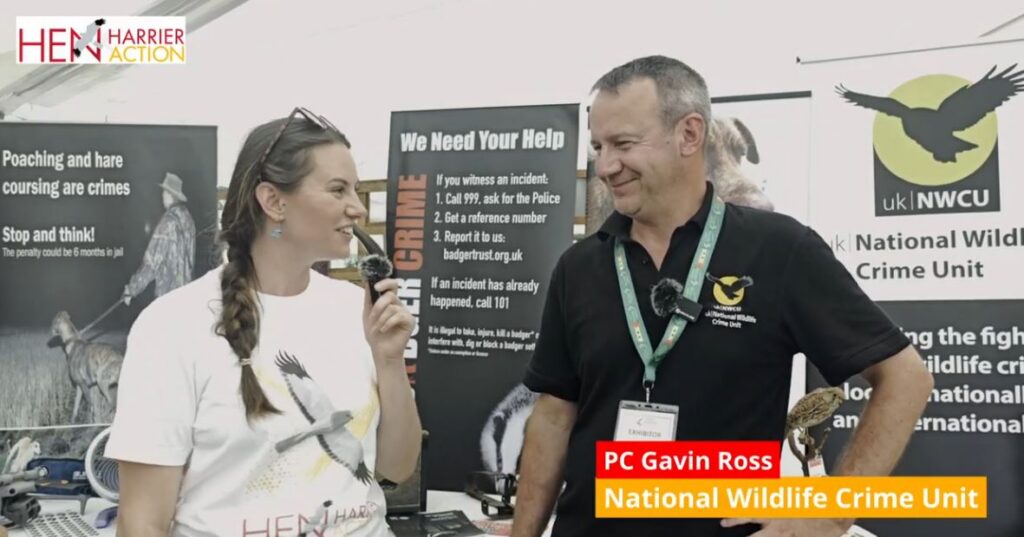
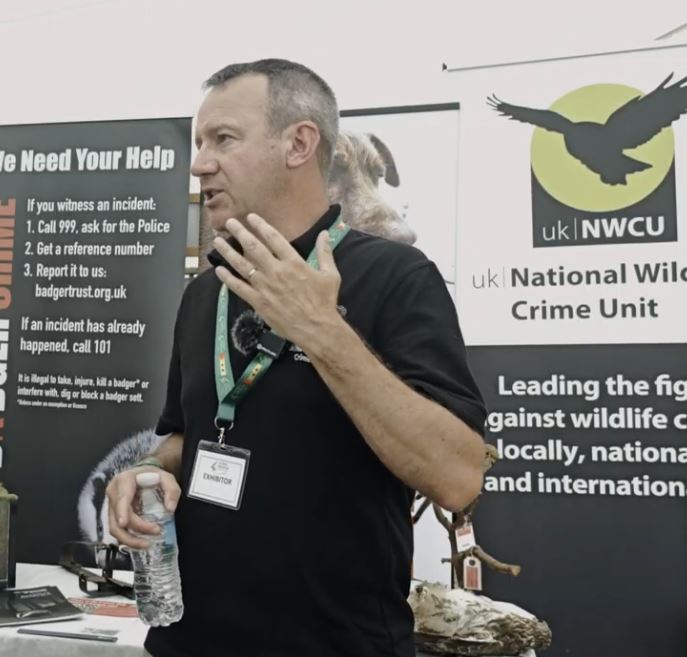
Back in July this year at Global BirdFair 2026, Trustee Becky Downey caught up with PC Gavin Ross from the National Wildlife Crime Unit (NWCU) for an in-depth interview. You can watch the video on our YouTube channel, or you can read below for some fascinating insights into the pursuit of wildlife crime, and the techniques used by the NWCU both to deter criminals, and bring them to justice.
HHA: Could please tell us and the viewers what the National Wildlife Crime Unit does and what your role within that is?
We’re a relatively small UK unit. There’s 18 of us and we’re a mix of warranted police officers. So, for example, I’m a Police Scotland officer seconded to the UK unit. I’ve been in the unit nearly 6 years and I’m an Investigative Support Officer covering Scotland, although we do travel south the border as well. I’ve got other colleagues who are police officers and detectives, but the majority in the unit are civilians. Investigative intelligence officers, analysts, people like that -because a lot of what we deal with is serious and organised crime.
So we require a lot of analytical work and intelligence work to create packages analysing these people and now we’re developing a financial aspect to it. So we have people gathering financial intelligence. Despite being a small unit we’re utilising all the investigative tools we possibly can to deal with what we view as evidence of serious and organized crime.
"...the estates committing the crime don't like it because it's very public. So it's a black mark on them"
HHA: Can you tell us a little bit more about the new legislation that’s come in for Scotland and what changes you’ve seen in Scotland because of that legislation?
If we are talking about legislation to protect raptors, there are big differences between Scotland and England and the legislation started with vicarious liability. If we charge a gamekeeper, for example, that same charge can potentially extend to the head gamekeeper, the factor, even the owner in terms of vicarious liabilities. Someone is vicariously responsible for somebody below him having committed a crime.
Beyond that, we’ve also got the general license restrictions. Very often we will have an investigation that at a civil burden of proof I can state categorically that somebody associated with this area of land has committed that crime. I just can’t evidence who. So from there I write a report that goes to Nature Scot and they can withdraw their right to use the general licenses.
Of course, there’s an appeal process. They can also apply for individual licenses, but it is a way of affecting them. And I think the estates committing the crime don’t like it because it’s very public. So it’s a black mark on them. And then the most recent one is grouse moor licensing. So we’ve had that now for over a year. We haven’t used that yet. I haven’t written any reports in relation to crimes that have occurred on grouse moors that could potentially lead to Nature Scot removing the right to use that general license which is the sanction that they potentially have.
But that’s a good thing if I haven’t had to report it, because the point of these legislative changes is to put protection measures in place to deter people – to make them think “I’d better not commit the crime”, because now we have all these tools. England doesn’t have any of them but I believe that there may be some legislative change coming in the future that would be positive.
The knock-on effect of these legislative differences is the crimes are different now between Scotland and England. In Scotland we have very little poisoning now, but we undoubtedly still have raptor persecution taking place. I think they’ve had to change the MO, so for example with poisoning we have a lot of eagles with sat tags attached to their backs. If one of them consumes a poison, it may not die on the poisoned bait. It may die elsewhere.
The person who has put that poison down wouldn’t know that has happened. But that tag will still keep pinging. But pinging a static signal. We get notified of that. We can then analyse the data, decide if there’s something suspicious, and if we think there is, then we’ve got grounds under legislation to go and search the land without a warrant. And that’s what we do. And we would recover that evidence and commence an investigation.
"..We've got specially trained dogs that are trained to recover bodies. I've used them a few times, and it is incredible what they can find."
HHA: When a potential case comes to the National Wildlife Crime Unit that you think you might need to investigate, what is the chain reaction then?
In relation to Hen Harriers the most common starting point is a notification from one of the organisations that are monitoring a satellite tag to say that it’s either ‘sudden stop no malfunction’ or it’s a stationary tag. We don’t take anybody’s word for that. We get the raw data and we’ll analyse that, and not just that immediate end point. We’ll go way back to see if has this happened before? Are there any inconsistencies? What’s happening with this tag? What are its normal patterns and are there sudden inconsistencies?
We’ve got one person in house, James Leonard, who’s a bit of a guru on the SAT tags. And there’s a group of five of us who share on call duties. We provide a 7 day a week on-call function so that people can contact us and tell us about anything suspicious. That leads to a formal referral, but we don’t take anybody’s word for anything. We look at the data and then decide if something suspicious has happened. And there’s a lot of data that could rise give rise to a suspicion.
If we decide it is suspicious then under Section 192 of the Wildlife and Countryside Act we have the powers to search land without a warrant. Depending on the circumstances, we may do a low-key semi-covert search, for example, to recover a static tag. If it’s a sudden stop, no malfunction, then we will make the local force aware of it and try and do a full search and use a number of resources.
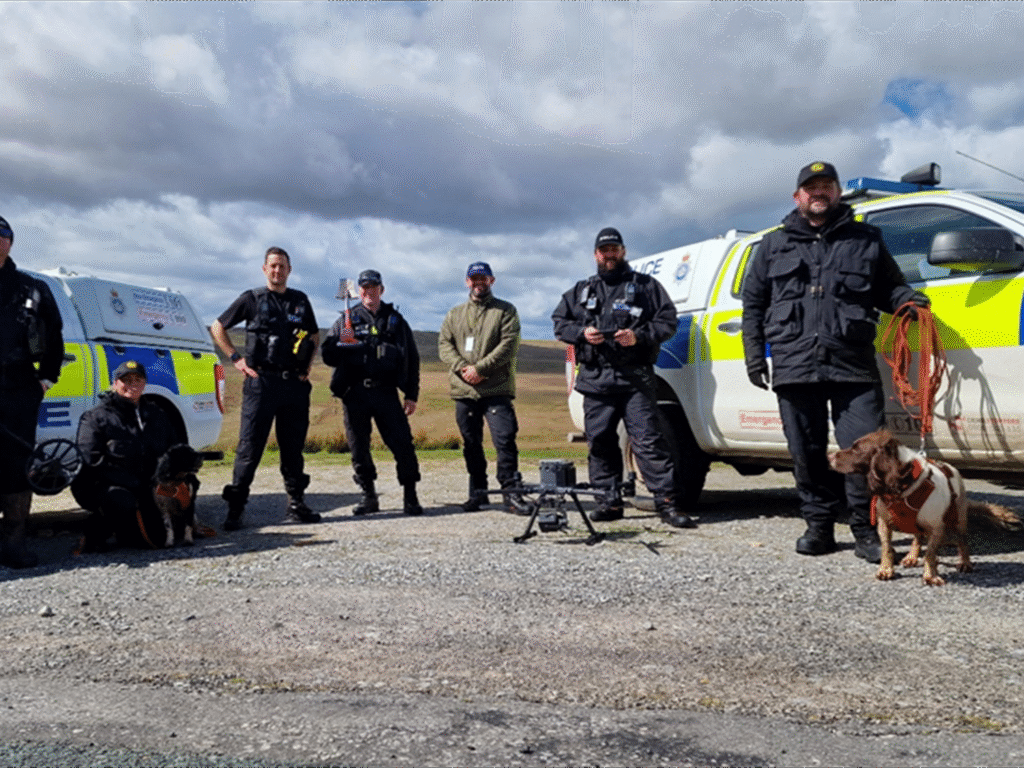
We’ve got specially trained dogs that are trained to recover bodies. I’ve used them a few times, and it is incredible what they can find. I remember going out with a line team of specialist police searchers and they searched a hillside backwards and forwards, shoulder to shoulder, search, search. Found nothing. The dog went on and found 10 things in 5 minutes. Absolutely incredible. It’s great. So we use dogs and drones – we’ve got an in-house drone capability.
I don’t want to reveal too much, but we have developed new technology on drones that can assist us in finding things that are very, very hard-dug into the ground. Stick that technology on a drone and it opens up a whole new area.
HHA: Can you tell us how long you’ve been doing this role?
I’ve been in the police for 27 and a half years. I became a wildlife criminal officer after only about a year’s service, but it was just an addition to my day job for the first 20 or so years of my service. I was an occasional wildlife crime officer when incidents came in. But it proved difficult juggling that with my day job, and then I was lucky enough 6 years ago or so to get this job, seconded full-time out of Scotland to the National Wildlife Crime Unit.
"They will also kill a large owl, or even a heron because on the day of a shoot, a big bird like that sailing over grouse will cause the grouse to hunker down into the heather..."
HHA: So in all of that time can you remember your first search of a grouse moor?
Yes, it was an estate in southern Scotland. And I remember it being a massive eye opener because even though this was probably about 24/25 years ago, I remember doing the under-keepers’ cottages. That was the area we were searching. There were dog kennels perpendicular to the cottages and there was a gap behind the dog kennels to a drystone dyke on a stone wall. And I remember walking down there and stuck in that wall was a dead tawny owl, a dead barn owl, a dead kestrel, a dead sparrowhawk, just huge volumes of small raptors that had been shot for no reason.
Now, I’ll never ever excuse the activity of somebody killing illegally killing a bird of prey, but I understand that they’ve got a motive. There’s no motive even for killing any of these small raptors that are no threat to them.
Although I have in recent years discovered – and it’s gamekeepers that have told me this – that they don’t just kill birds of prey because they take grouse. They will also kill a large owl, or even a heron because on the day of a shoot, a big bird like that sailing over grouse will cause the grouse to hunker down into the heather and not take off when the when the beaters reach them to drive them towards the chute. So, they’re not just killed because they take grouse. They’re killed because they’re a nuisance as well.
That sits very uncomfortably with me, I have to say.
HHA: Do you remember what happened in that case? Are you able to say?
I think that was the first case where there was ever a general license restriction imposed on an estate. If it wasn’t that case, it was the next time I searched an estate. I’ve been on there a few times.
"...the truth is we have grouse moor licences in Scotland because of criminal activity that took place from the year 2000 onwards."
HHA: What role can you see other gamekeepers playing in helping prevent wildlife crime on estates?
I think that’s a really good question because, generally, you can’t enforce your way out of a problem. And this is a problem that is associated with traditional activities. It’s associated with a multi-million pound industry. It’s associated with business models that from my point of view are potentially flawed because it requires complete predator eradication for maximum available grouse to be shot.
However, there are some amazing estates which are full of wildlife and the story to tell on these estates is amazing. People who go shooting there will see eagles, they’ll see harriers, they will work with dogs for a walked up shoot. I think that’s really good and I’d like to see that as a future of that industry, more towards that than bag size.
I do think that a lot of people involved in that industry perhaps feel a lot of people are having a go at them. They’re trapped in the corner of a room and they’re trying to fight their way out rather than listen to what the issues are. Because the truth is we have grouse moor licences in Scotland because of criminal activity that took place from the year 2000 onwards. The statistics that were assessed, the incidents that were assessed, point to evidence that the criminality is still taking place. So it was the behaviour of gamekeepers that led to this legislation. If they had been squeaky clean, if these crimes hadn’t taken place, they wouldn’t now be legislated against.
It’s not that outsiders are having a go. It’s coming from within. So the change has to come from within. I think some of the shooting organizations are absolutely superb and we have really good relations with them. We can use them to highlight good practice.
I want a keeper, or anybody who’s going to commit a wildlife crime, just before they commit that crime, to think of the potential ramifications and that’s enough to make them stop. They’ve got to think, “okay, I know there’s nobody about. I might not get caught for it, but there’s some consequence to that action.”
And that sort of prevention angle is really good. So, for example, recently we’ve been running an operation involving simple community policing techniques of knocking on doors, putting up signage, just talking to people. And that has led to success. For example, I’ve got a peregrine falcon nest from last year that had failed for seven years in a row. It succeeded this year. And another one from this year had failed under suspicious circumstances 20 years in a row, but a number of peregrines fledged last week. So that’s an easy win. I’m happy if I’m knocking on doors putting leaflets out, putting some signs up and chatting to people if that’s enough to stop the crime. That’s more important than the crime happening and then catching somebody.
How do you feel about the future in the UK for birds of prey? In particular the Hen Harrier. Is it a positive story?
We’re in a time of change. So if I reflect upon the area that I work and I live in, the south of Scotland, I’ve got the South of Scotland Golden Eagle Project. Under license are translocating birds from where there’s a healthy large population such as the Outer Hebrides down to the south of Scotland, because of scientific evidence. They’re not going to move and recolonise these areas themselves. They need a helping hand. And that project’s been working really well. Massive success.
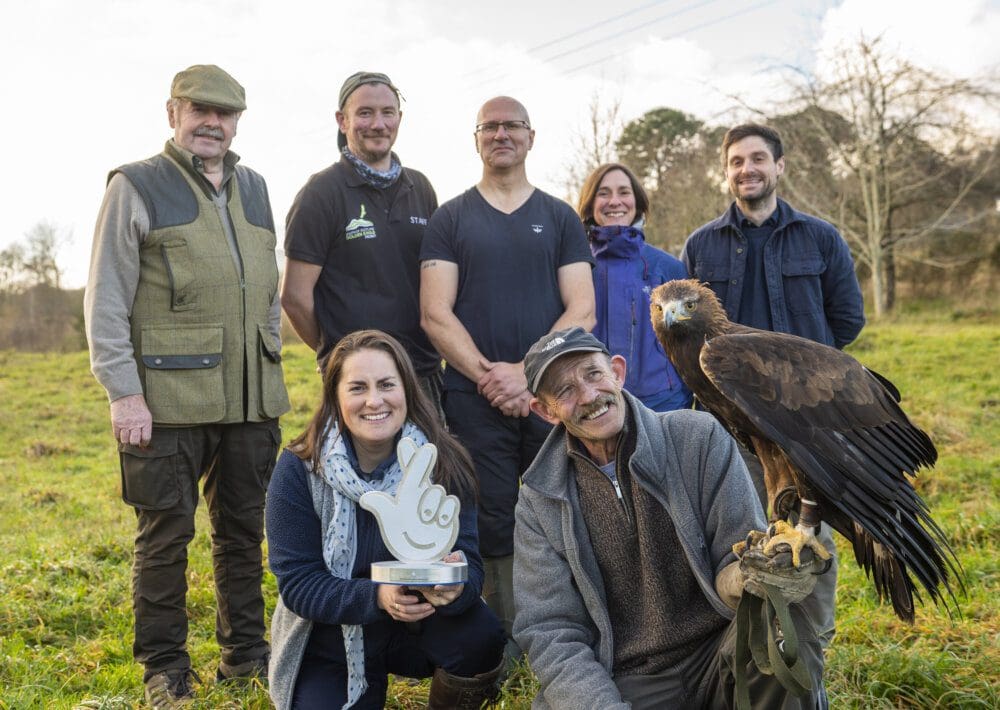
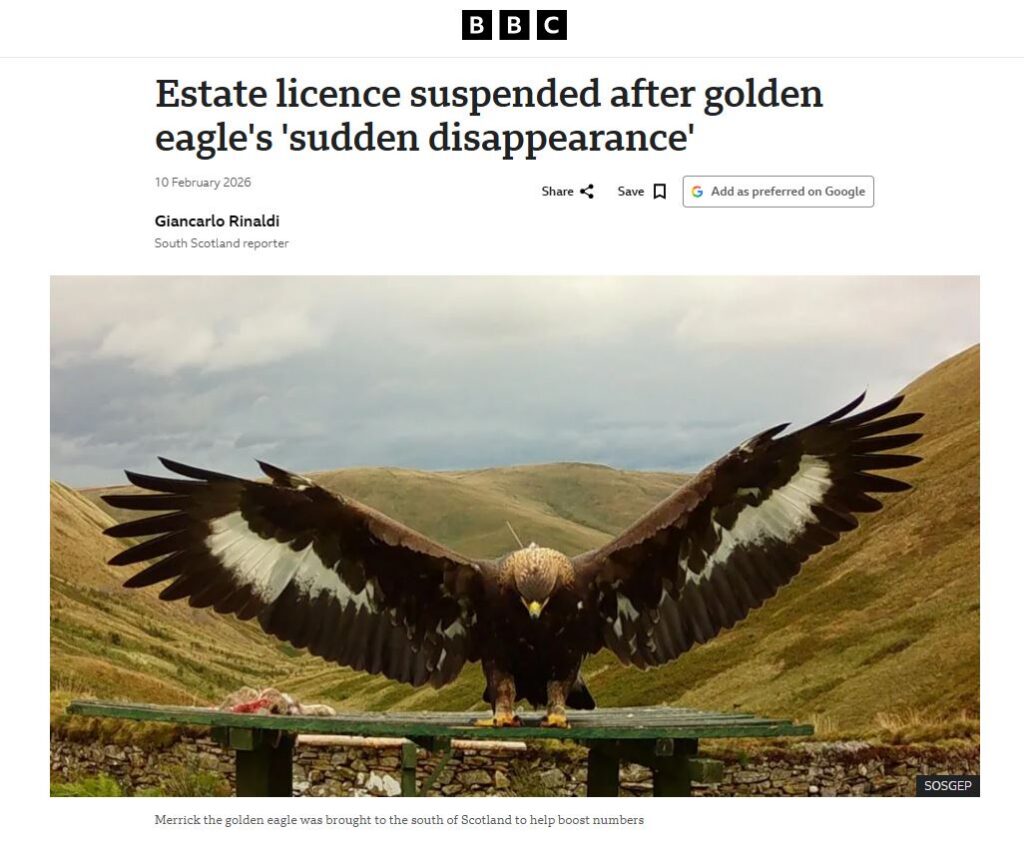
Unfortunately this year there have been some negatives. At least two of their birds have been shot this year. So you’re creating new human-wildlife conflict areas where birds like eagles have historically been made almost locally extinct in these areas. Putting them back has reignited that conflict. But it’s up to people to behave themselves, and if you now have this bird back there, you know you can’t break the law.
Regarding Hen Harriers, the statistics are misleading, because yes a few years ago, around 2016, there were just two nesting pairs of harriers in the whole of England and now it’s viewed as a success because there are more. But it’s still a fraction compared to what there should be. The starting point is too low and the increase is too slow. I want to see a lot of change. I just want the crime to stop, and I think if the crime is removed then we would see an exponential growth.
One last word from Gavin.
We have to remember that not all, in fact a very small proportion of Hen Harriers have satellite tags fitted. So we can’t just rely on that as our sole intelligence source.
Operation Owl is encouraging people that if you see something suspicious, report it to the police. I don’t need you to tell me exactly what is the crime that’s happened, this is who did it, this is when they did it. This is how.
No. You’re suspicious of something. If it’s not right, whatever that might be, you suspect a wildlife crime may have been committed. Contact the police.
If you want to support the work of Hen Harrier Action, which also helps support the work of the National Wildlife Crime Unit, then please subscribe to our email newsletter for all the latest news.
We often run fundraisers to help fund satellite tags. We also run fundraisers to help train up these amazing dogs that Gavin talked about and deploying detection dogs that help track down and find birds that have been persecuted.