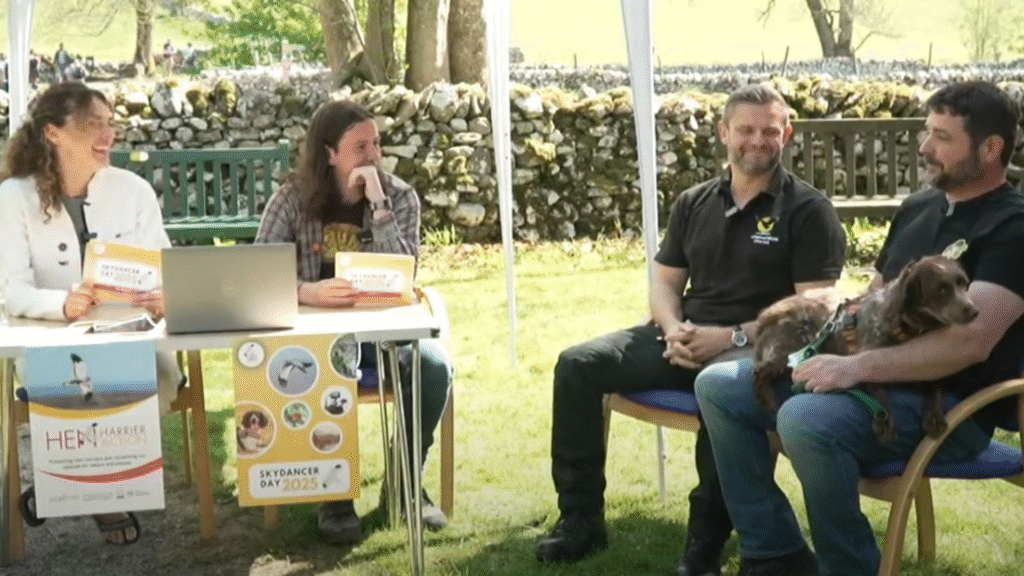


One of the fundraising campaigns that Hen Harrier Action launched last year at Skydancer Day in the Yorkshire Dales, after an interview with DI Mark Harrison of the National Wildlife Crime Unit, was to raise money to train and deploy wildlife crime detection dogs.
On the day we met detection dog Gem and handler Kevin, and the part of the money we raised with that successful campaign was to train Gem to detect bird remains and satellite tags.
Thanks to your generous donations, we were able to announce that by October, Gem was fully trained for deployment on bird of prey crime investigations, and she joined her canine colleague Henry, already a veteran of wildlife crime searches with the NWCU and multi-agency teams.
Now Henry, winner of the IFAW Animal of the Year award last year, has featured on BBC Crimewatch Live in a video highlighting the work of Louise Wilson and her Conservation K9 Consultancy team, and revealing the backstory of rescue dog Henry, already rejected from five homes for his unruly behaviour.
Louise had just returned home from a trip to South Africa helping train dogs for conservation when a rescue centre got in touch. “They said, we’ve got the perfect dog for you, Henry. He’s eight months old and he’d been in five homes already. I was told he was difficult and unruly.”
As an experienced dog trainer, Louise felt it wouldn’t be difficult to train Henry, but she hadn’t anticipated how different he would turn out to be. “We spent a good year for him to get used to having a bond with us and having trust and having a relationship. He did test me every single day, but he settled in the home environment perfectly. I trusted him and he loved the ball.”
“I started training him on tobacco detection. He was absolutely brilliant at that. He loved the idea of ‘I find this smell, you give me my ball.’ But when putting him in small confined spaces, he didn’t thrive. But when I was doing conservation-led work, he would really come into himself.”
Louise was approached by the NWCU asking for help with finding dead birds of prey and satellite tags. She knew that his strength and endurance made Henry the ideal dog for this job, where the search teams often need to cover vast areas of moorland to locate remains.
“Henry will find concealed remains or a bird’s skull, even under a lot of vegetation, sometimes within 5 or 10 minutes. You can rest assured that if the bird was here, he is going to find it.”
Henry and Gem have been deployed many times now with multi-agency search teams including NWCU officers, local police and RSPB Investigations staff on searches for missing birds of prey, including Hen Harriers, Buzzards and White-tailed Eagles.
Louise adds, “He still surprises me, even now, and he’s 10 years old, but he is a dog that I’m so glad to have with me – he’s taught me so much.”
Last October, Louise received an email inviting her to the International Fund for Animal Welfare annual awards, where he received the Animal of the Year award for his contribution to conservation over the last 10 years. As Louise admitted, “It really made my heart flutter when they said that. Henry did me proud.”
“Without a doubt, there’s no other dog like Henry. After 22 years of working with dogs, I haven’t met another dog like him, and doubt I ever will.”
We use cookies to improve your experience on our site. By using our site, you consent to cookies.
Manage your cookie preferences below:
Essential cookies enable basic functions and are necessary for the proper function of the website.
Google reCAPTCHA helps protect websites from spam and abuse by verifying user interactions through challenges.
Statistics cookies collect information anonymously. This information helps us understand how visitors use our website.
Google Analytics is a powerful tool that tracks and analyzes website traffic for informed marketing decisions.
Service URL: policies.google.com (opens in a new window)
You can find more information in our Privacy Policy and Privacy Policy.