Four New Satellite Tags Fitted This Summer Thanks To Your Generous Donations
Our second Christmas Appeal, launched in December 2024, was as generously supported as the original campaign, and raised sufficient funds to sponsor four satellite tags. Now that the breeding season is over, the tags have been fitted and the chicks have fledged, we can reveal the four young Hen Harriers that were tagged thanks to your donations.
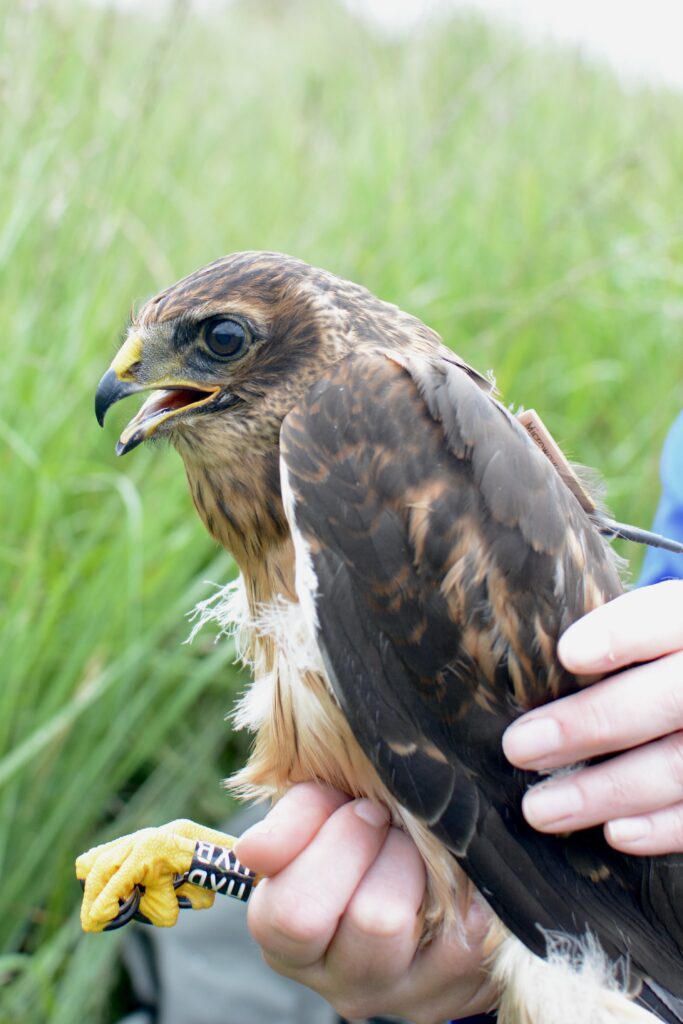
All four birds are females. Frigg was born from a nest on the Isle of Man. Circe and Henrietta were two of three siblings that fledged from the Tarras Valley Nature Reserve in Dumfries and Galloway. And Clara was tagged from a nest on the isle of Colonsay, one of the Inner Hebrides.
Frigg, a young female satellite tagged Hen Harrier born on the Isle of Man
Circe, a satellite tagged young female Hen Harrier born on the Tarras Valley Nature Reserve
Clara, a young female Hen Harrier born and satellite tagged on the Hebridean island of Colonsay
As always, we are hugely grateful to our partners in the field – RSPB Investigations, the Scottish Raptor Study Group, Manx Birdlife and Manx Wildlife Trust – their patience and dedication ensured that the nests were constantly monitored, the satellite tags were fitted, and the birds successfully fledged during what was a long tagging season, from mid-June up to the last day of July.
Clara, the young female Hen Harrier born on the Inner Hebridean island of Colonsay, was tagged on the 16th of June, one of two siblings tagged with help from the Argyll Raptor Study Group. She has been seen since fledging on neighbouring Oronsay.
Circe, named after the enchantress goddess of Greek mythology, was tagged on the 21st of June at Tarras Valley Nature Reserve, where another very successful Hen Harrier breeding season saw 9 chicks fledge this year.
On the 8th of July, RSPB field workers on the Isle of Man, with the support of Manx Birdlife and Manx Wildlife Trust, tagged Frigg, named after the Norse goddess, wife of Odin. She has already left the natal area and is exploring England.
And finally, on the 22nd of July, a satellite tag was fitted to a second female from Tarras Valley – named Henrietta by a group of schoolchildren on a summer bushcraft workshop at the reserve.
Henrietta, a satellite tagged young female Hen Harrier born on the Tarras Valley Nature Reserve
Tarras Valley Nature Reserve Delivers Breeding Success Again for Hen Harriers
Last year, the Tarras Valley Nature Reserve successfully fledged eight Hen Harrier chicks, including our own satellite tagged bird Gilda, who is currently exploring Gladhouse Reservoir, near Edinburgh.
This year, the remarkable community-led rewilding project, encompassing over 10,000 acres of land bought through public fundraising campaigns in 2021, has successfully fledged a further nine Hen Harrier chicks.
It’s an astonishing achievement, in the face of continuing declines in Hen Harrier populations elsewhere in the UK.
We asked Jenny Barlow, the Reserve Manager at Tarras Valley, about the secret of their success.
“Honestly the main thing is just leaving them alone to do their thing! We have a fantastic volunteer network through our raptor group (Dumfries & Galloway Raptor Study Group) who are so incredible in helping to monitor the birds and safeguard them,” Jenny told us.
“The local community are also engaged in knowing how to avoid disturbance to ground nests and that helps so much to support the birds get the space and peace they need to raise their young successfully.“
She added: “The upland mosaic of grass, heather and scrub on the reserve helps provide an ample habitat for small birds, which in turn provides an ample food source for breeding Hen Harriers and we hope this will increase as the land restores.”
Jenny Barlow, the Reserve Manager at Tarras Valley Nature Reserve
Once again we would like to express our huge gratitude to all the fieldworkers from the RSPB, Raptor Study Groups and the Nature Reserves who put in enormous effort to monitor and protect Hen Harriers throughout the breeding season, and fit the satellite tags that provide us with invaluable data to monitor the location and health of our young Hen Harriers.
And we would like to thank all those Hen Harrier Action supporters for their generosity in funding satellite tags to protect this rare and iconic bird.
To learn about the four Hen Harriers tagged with your donations in 2024, click here. To find out about the suspicious disappearance of one of that cohort – Sita – click here.