At our annual Skydancer Day live broadcast this year, one of the most popular items was a visit to RSPB Sherwood Forest with Hen Harrier Action Co-chair Indy Kiemel Greene.
Now 20, Indy has volunteered at the reserve since he was 14, and in this film he reveals the remarkable work that he and fellow volunteers have been doing alongside RSPB staff to restore and transform this ancient forest, home to Europe’s largest collection of ancient oaks.
You can read his story below, and watch the short film on our YouTube channel.
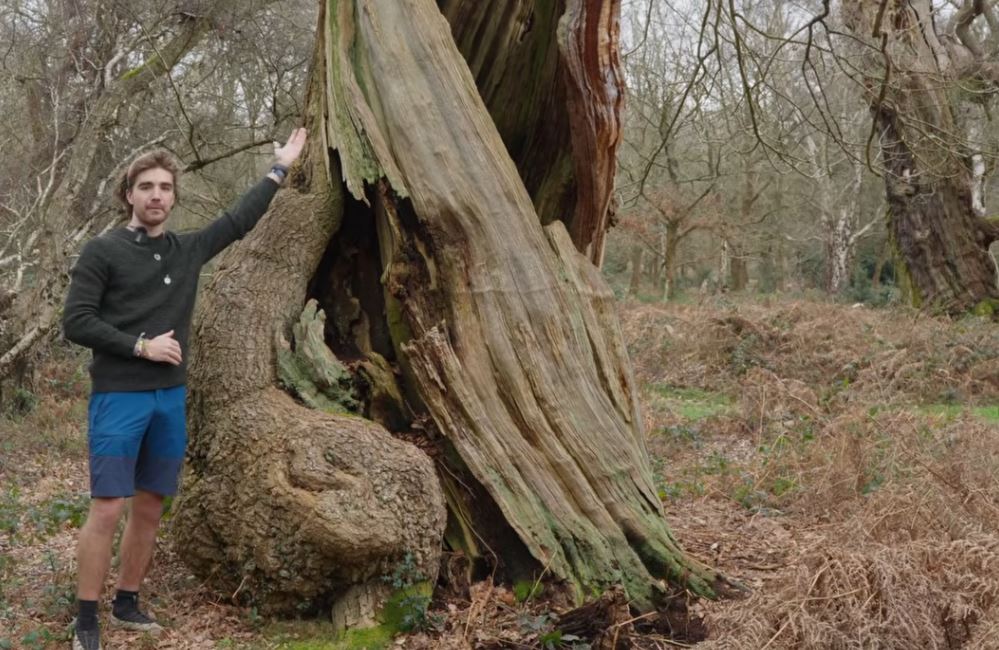
“Welcome to RSPB Sherwood Forest. I’ve been volunteering in the forest with the RSPB since I was 14. And I still enjoy it just as much now as I did then. And my plan for today is to take you on a bit of a tour around the forest to show you just the power and the strength in volunteering and what I’ve got out of it because I’ve met so many amazing people, seen so many amazing species, and learned so much about the forest that I would really love to take you on a little tour.
Twister is my absolute favourite tree in the forest just because it’s a tree that twists. It’s unbelievable. But the most amazing thing about this tree is that it’s still alive. This whole section of bark carries all the nutrients that it needs up the back limb where it twists and feeds all these branches up in the canopy. But there’s nothing inside. All the heart is rotted away. There is no innards to this tree. It’s literally the shell all the way across the outside keeping it up. But I’ve never seen a tree anywhere in the world that looks quite as spectacular as this.”
"Sherwood has the largest collection of ancient oaks in Europe"
“Let’s look at the forest floor of RSPB Sherwood. You join me sat on a beautiful log that used to be a big ancient oak. The RSPB have had management rights in the forest since around 2018. And they’ve really transformed the forest for the better. What you can see behind me is what we call woodland pasture. It’s not just a woodland, it’s not just a monoculture and it isn’t just a monoculture in terms of the understory either. It’s a mishmash of lots of different habitats. There are bits of scrub in the mix, bits of open ground floor for ground nesting birds to forage and nest.
And of course some of the fantastic ancient oaks, the next generations and the younger ones. We have a whole generation of oak trees coming through here because what makes Sherwood so special is those ancient oaks. We have the largest collection of ancient oaks in Europe here – 997 ancients.”


“This is a magnificent ancient oak tree. The size of it, the width of the trunk and the breadth of the branches is an unbelievable example of an ancient oak. And this is exactly what we’re trying to protect.
We’ve removed some of the lower shrubs that go around the trees. It’s called ‘haloing’. Opening up the surrounding area to make sure that this tree gets as much light in as possible, because the way these trees age is that they start to fall away from the top when as they get older and they can’t support these larger limbs anymore. They start to drop. Then they start sending out shoots like these to gather sunlight. But of course if you have loads of tall trees around catching all the sunlight at the top of the canopy these lower branches aren’t going to get any. So the haloing just allows trees like these to keep going for as long as possible.
But what I also love to think about is what this tree has seen. This tree could be 600 or 700 years old. So many moments in history that this tree has borne witness to just by doing its thing. To think that this tree supports hundreds if not thousands of different life forms is really quite something.”
Creating spaces for priority species like Nightjar and Woodlark

“We’re now on the heathland. This is called Budby. And again multiple priority species here but two of the main ones are Nightjar and Woodlark. And in this area we are in particular on the western side of the reserve is one of the first places that Nightjar were recorded on site and they’ve been doing really well. However, we always recognize that some bits of the reserve could perform better for birds like these. So, what we’ve done here is open it up to create a bit more of a glade to encourage Nightjar because they’re a ground nesting bird, but they still like a bit of shelter, a bit of protection. There’s a couple of things we’ve done here.
This whole area around me here used to be a big block of pine, and we’ve chopped it down, removed it in some cases, but sometimes we’ve left them. In places like this, we’ve managed to ‘pleach’ it here – interlace the trees and shrubs – so it creates a nice bit of shelter beneath the pine and also potentially even a perch for Nightjar to chur – that fantastic haunting sound you hear in the lovely late summer evenings. We’re not wasting any of the timber. This is still of interest to us.
Nightjar are a ground nesting bird, but they also need their privacy and they are quite susceptible to disturbance. That could be from dogs, that could be from people, predators, things like that. So we’ve used some of the timber here is create a bit of a screen. We’ve felled some of the trees to make it a bit harder for some of those species (or people) trying to get in towards the Nightjars. It just gives them that little bit of extra privacy, that little bit of extra space and protection within this glade. And none of that timber is wasted.”
“In the distance, we also have a log pile with some of the larger trunks that we decided to wedge between those two trees. And that will rot down over time and create that fantastic dead wood habitat, which is so important.
This is what I really enjoy about volunteering because there’s a number of these glades that we’ve opened up. And I’m also involved with the surveys here on site. And when you’re surveying these fantastic areas and you see a new pair of Nightjar or Woodlark or any other bird that’s set up camp in one of these areas that we’ve opened up, it is the most satisfying feeling knowing that you and that fantastic group of people have done our bit and it’s actually resulted in a new territory or a new set of birds moving into the area.
But of course in Sherwood and on the heathland, it’s all about trees. And another benefit of opening up this area is to enhance the life of the next generation of oak trees, giving them as much light around its lower branches as we possibly can.”

“RSPB Sherwood is an absolutely fantastic woodland, well managed and with so many species. They’re all thriving in the forest which is brilliant and it gives me a huge amount of pride to be able to volunteer here and to have done my bit along with other amazing volunteers helping out within the woodland making it better for people and nature.
But the problem is still the lack of woodland.
You can look out over this expanse and although it looks big in the grand scheme of things, it really isn’t. Look out over the surrounding landscape and you can see how fragmented it is. You’ve got fields here. You got the farmland, the forestry, the villages; the roads all cut up what used to be an absolutely ginormous woodland. And now we just have these fragments left. My message – and what we all need to strive for, I believe – is larger, healthier landscapes managed in the same way the RSPB have managed Sherwood here so brilliantly.
We need larger resilient landscapes if we have a chance of saving nature.”