Last year at Skydancer Day in the Yorkshire Dales, we met DI Mark Harrison from the National Wildlife Crime Unit and detection dog Gem with handler Kevin from Conservation K9 Consultancy. Having heard just how effective they were in the fight against wildlife crime, we took the opportunity to launch an appeal to fund the training and deployment of more detection dogs in the field.
The appeal was a huge success, raising over £11,000 in less than three weeks. The funds have been used to train more dogs, like Gem, on locating bird remains and satellite tags, and deploying these remarkable canine detectives on searches, often on difficult terrain.
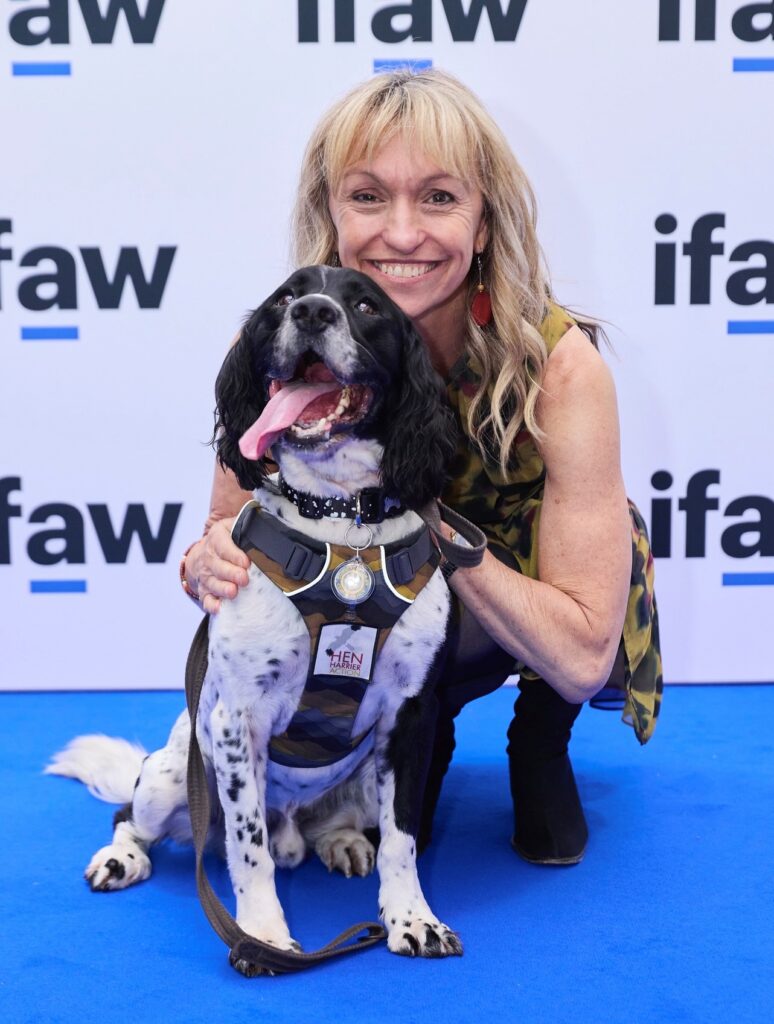
In October, we learned that detection dog Henry, proudly sporting a Hen Harrier Action badge, had won Animal of the Year Award at the IFAW annual award ceremony.
We’ve just received an update from the NWCU on recent deployments funded by your generosity.
Wildlife Crime Detection Dogs Deployed across England, Wales and Scotland in Vital Evidence Searches
Gem, Twist and Henry, three of the remarkable detection dogs from Louise Wilson’s Conservation K9 Consultancy, have been busy in recent months supporting multi-agency searches co-ordinated by the National Wildlife Crime Unit. And with a sense of smell at least 100,000 times more sensitive than ours, they have provided vital assistance in locating bird carcasses and remains, and even pinpointing satellite tags that have been deliberately removed.
Altogether, your donations have funded seven crucial deployments since September 2025, alongside training to detect lone tags. Now the team have another detection dog – Pudding – in training, again thanks to your generosity.
Two of the seven deployments have resulted in live investigation cases which may result in a prosecution, and we can’t provide any information while the investigation is ongoing. Of the remaining five deployments, two were in Wales, one was in Scotland, and the two English searches were in Northumberland and North Yorkshire, both raptor persecution hotspots.
In September last year, detection dogs Henry and Gem took part in the search for evidence and the carcass of a suspected illegally killed Golden Eagle in Dumfries and Galloway.
The same month, Henry and Twist were deployed on a search in North Wales for the remains of a young female Hen Harrier that fledged three months earlier from a nest on National Trust land in the Peak District.
After tracking data on the 31st August indicated she was no longer alive, a search on the 2nd September located the tag – but no sign of the bird’s body – on notorious persecution hotspot Ruabon Moor near Wrexham. Forensic analysis confirmed that the tag had been deliberately cut off with a sharp blade. Sgt Peter Evans from North Wales Police said the bird’s harness had been “intentionally severed“.

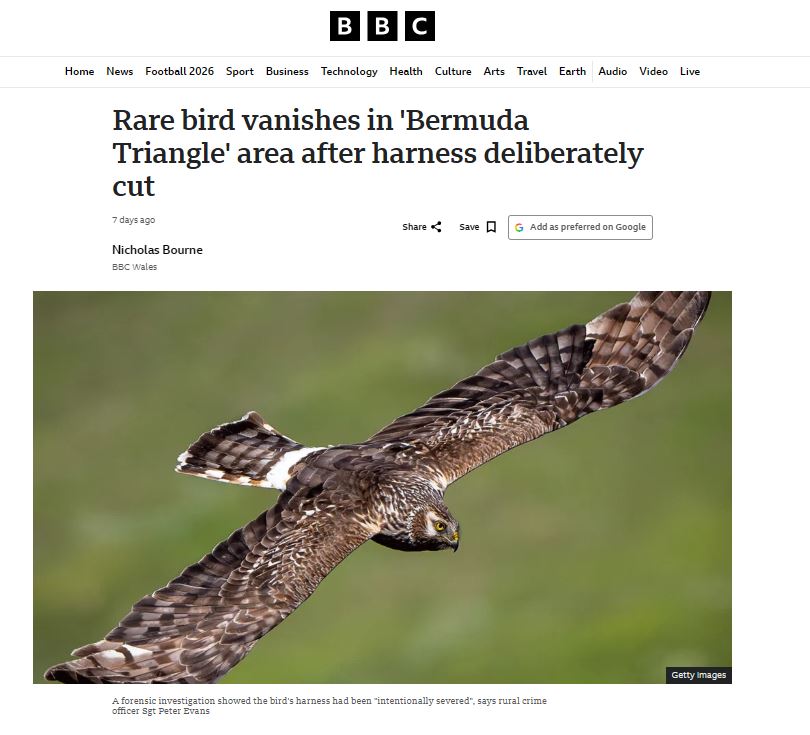
The case has been the subject of widespread national news coverage, with the area being described by the RSPB’s Mark Thomas as Wales’s ‘Bermuda Triangle’. He said: “This three-month-old bird survived for just three days in the area before it vanished in highly suspicious circumstances.
Based on years of evidence and intelligence, we suspect the criminal shot the harrier, cut the harness off the Hen Harrier’s body, discarded the tag and disposed of the body in separate locations to avoid detection.”
Between 2018 and 2026, there have been five suspected persecution incidents in this area involving Hen Harriers, with satellite tags discarded or harnesses showing evidence of human interference, along with many other disturbing incidents of persecution and trapping, as Raptor Persecution UK has noted.
Another search in Wales involving Henry, also in September 2025, was for an illegally killed White-tailed Eagle, yet another case where the satellite tag had been intentionally cut from the bird and hidden in remote woodland near Newtown, Powys. To combat this increasingly common strategy by wildlife criminals, the National Wildlife Crime Unit have used some of the Hen Harrier Action appeal funds to provide further training for the dogs on detecting lone satellite tags, having been removed from the bird.
In October last year, detection dog Henry assisted the again in the search for another Hen Harrier missing in suspicious circumstances, this time close to a persecution hotspot in Northumberland.
And more recently, in May this year, Henry was once again involved in a case that sparked more national media interest, the fate of a suspected illegally killed White-tailed Eagle in North Yorkshire.
The bird, a satellite-tagged chick born in 2025 in Dorset – the first breeding success of this species in the county for 240 years, as a result of the efforts of the Roy Dennis Wildlife Foundation – had roamed the country widely ahead of it’s suspicious disappearance. After wintering on the south coast, in spring it flew right up through England and up to the Loch of Strathbeg in Aberdeenshire, according to Tim Mackrill from the Foundation. Having returned to Dorset, it then headed north again, this time to the North York Moors.
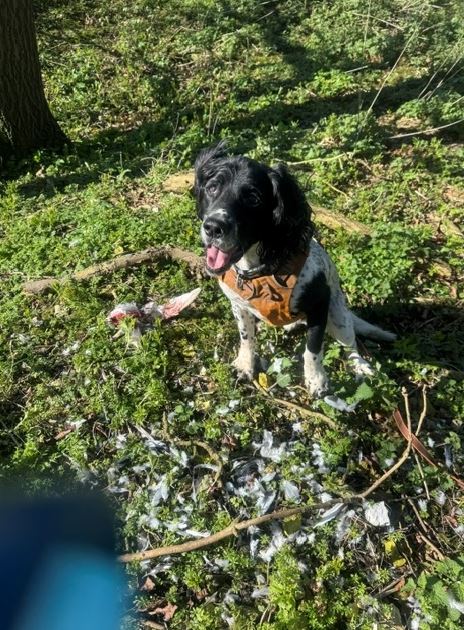
According to the tracking data, the bird arrived on the North York Moors at some point on 30 April. It was at a roost site and still alive at 1.20am the following morning, when the last signal was received.
“Then it went offline and we have had nothing since,” said Mackrill. Police officers visited the last-known location and nothing was found. After the signal went dead, estate staff assisted the human and canine search teams, but came up empty-handed.
As the RSPB’s Thomas pointed out, “This eagle has vanished in … the worst county in the UK for bird crime. North Yorkshire is consistently the worst and has been for decades.” He further speculated, “If you’re asking me to look at the probability … it’s most likely the bird has been shot. And if the bird is shot whilst it’s roosting, then it’s being shot at night, potentially with thermal imaging gear.”
Although the challenge of locating sufficient proof to pursue a prosecution remains daunting, as wildlife criminals evolve new strategies to hide the evidence of their crimes, we applaud the work of the RSPB Investigations Team, the National Wildlife Crime Unit and the local rural crime officers in their determination to stamp out illegal persecution. And we are proud to be able to help by funding the deployment of Conservation K9 Consultancy‘s remarkable detection dogs, like Henry, Gem, Twist and soon Pudding too.
NWCU Investigative Support Officer James Leonard told us, “The use of Louise and Kevin, coupled with their highly trained dogs, has been invaluable to the work of the local forces and that of the National Wildlife Crime Unit. Many thanks for the support of Hen Harrier Action for our work in investigating crimes against our iconic birds of prey.”