The Hen Harrier is native to the British Isles and breeds in our upland hills and moors. It is a bird of prey, also known as a raptor, which feeds mainly on small birds and mammals.
It is one of our most charismatic birds, famous for its breathtaking spring display, which gives it the nickname “Skydancer“. It is also one of the rarest and most persecuted birds of prey in the UK.
On this page you can find out how to identify a Hen Harrier, what it sounds like, where to see one, how many there are in the UK, and why they need our help.
Hen Harrier facts:
- Scientific name: Circus cyaneus
- Length: around 48cm
- Wingspan: around 110cm
- Weight: males around 350g, females larger at around 500g
- Diet: mainly small birds such as Meadow Pipits, and small mammals such as voles
- Nest: on the ground, usually deep in heather
- UK population: 653 territorial pairs (2023 national survey)
- Status: red-listed as a Bird of Conservation Concern in the UK, although classed as Least Concern worldwide
- Protection: fully protected under the Wildlife and Countryside Act 1981, and listed on Schedule 1, which makes it an offence to disturb them at or near the nest
How to identify a Hen Harrier
Male and female Hen Harriers look so different that early naturalists believed they were two separate species.
The Male Hen Harrier
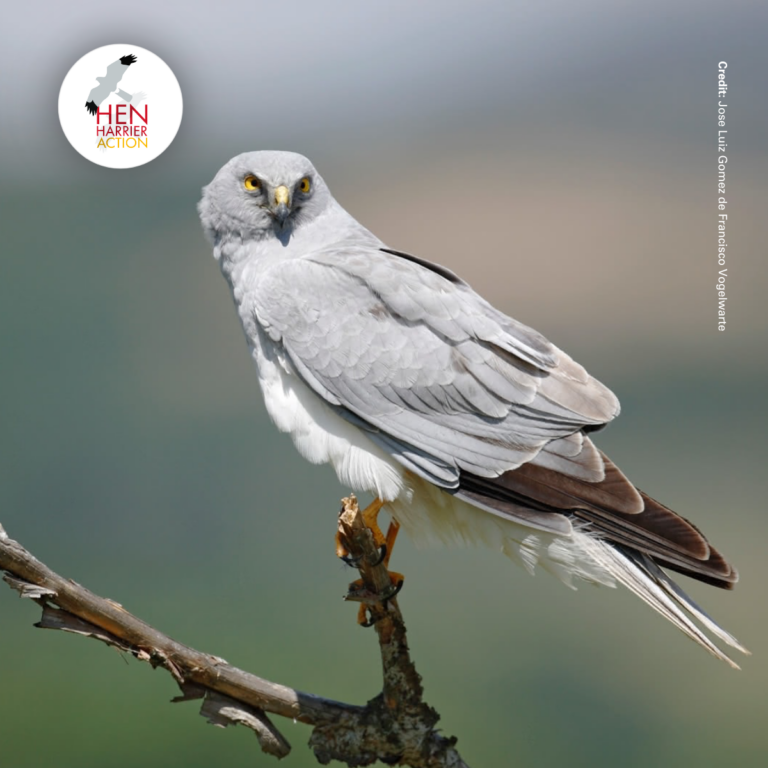
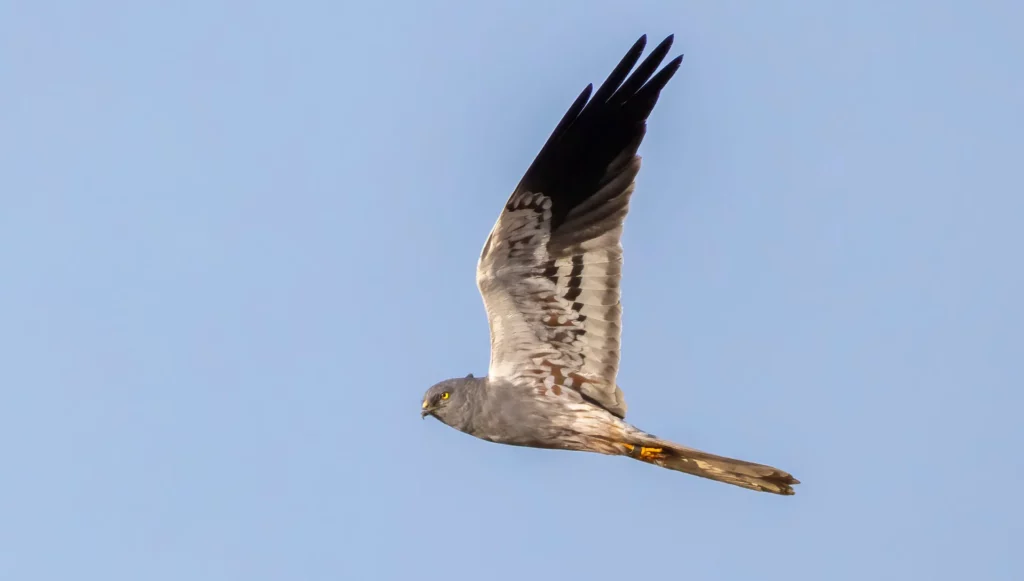
The adult male is a pale, silvery grey above, mostly white below, with black wingtips and a dark trailing edge to the wing. He has a white rump and a long grey tail. Seen gliding low over a moor on a grey day, he can look almost ghostly, which is why birders often call him the “grey ghost”.
The female hen harrier and young birds
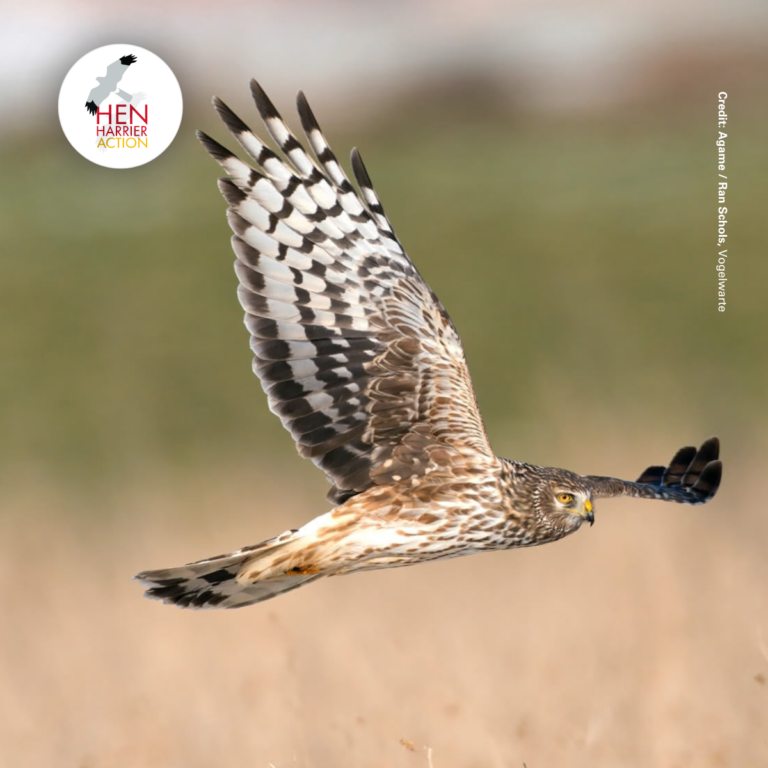
Females and young birds are brown, with streaked underparts, a bright white patch at the base of the tail and a banded tail.
Those bands give them the name “ringtail”. The female is noticeably larger than the male, and her softer colours make her much less conspicuous on the nest.
Hen Harrier in flight
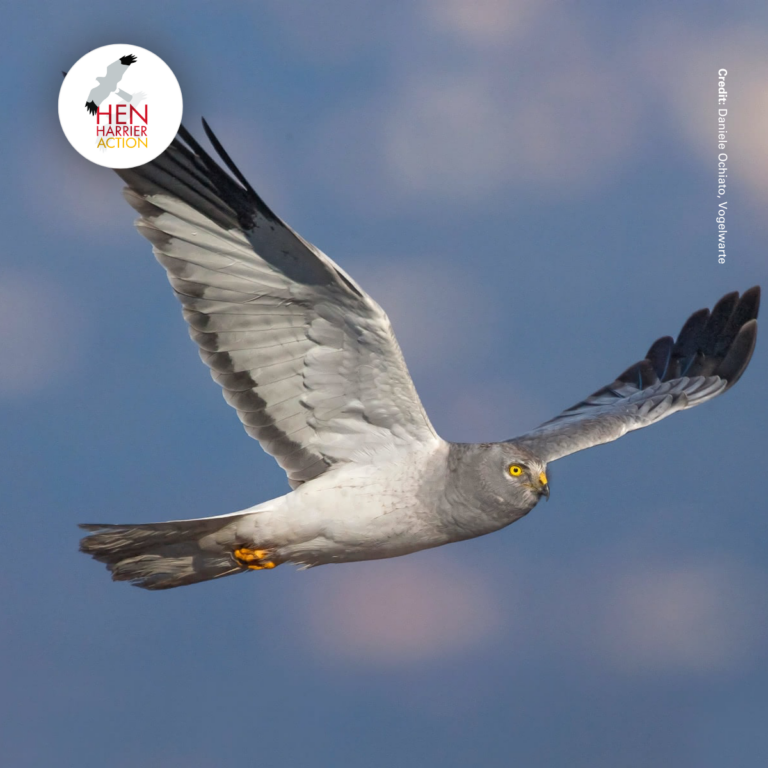
Harriers hunt by flying slowly and low over open ground, quartering back and forth, then dropping suddenly onto prey.
They glide with their long wings held in a shallow “V”, and their long tail and slim build give them a buoyant, almost weightless look.
That low, tilting flight is often the best clue that you are watching a harrier and not another bird of prey.
Hen Harrier or Buzzard?
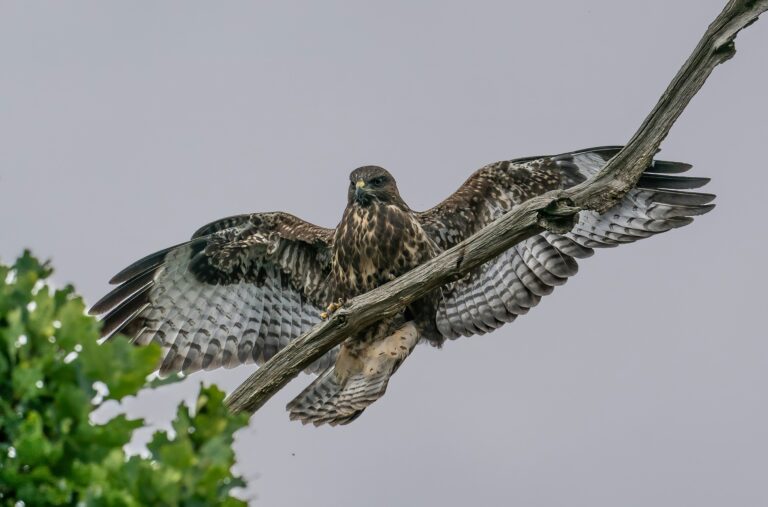
A Common Buzzard is a similar length to a Hen Harrier, but it is a much bulkier bird with broader, rounder wings and a shorter tail, and it can weigh twice as much.
Buzzards often soar in circles high overhead or sit hunched on fence posts. Hen Harriers are slimmer and longer tailed, and they usually hunt close to the ground.
Hen Harrier or Marsh Harrier?
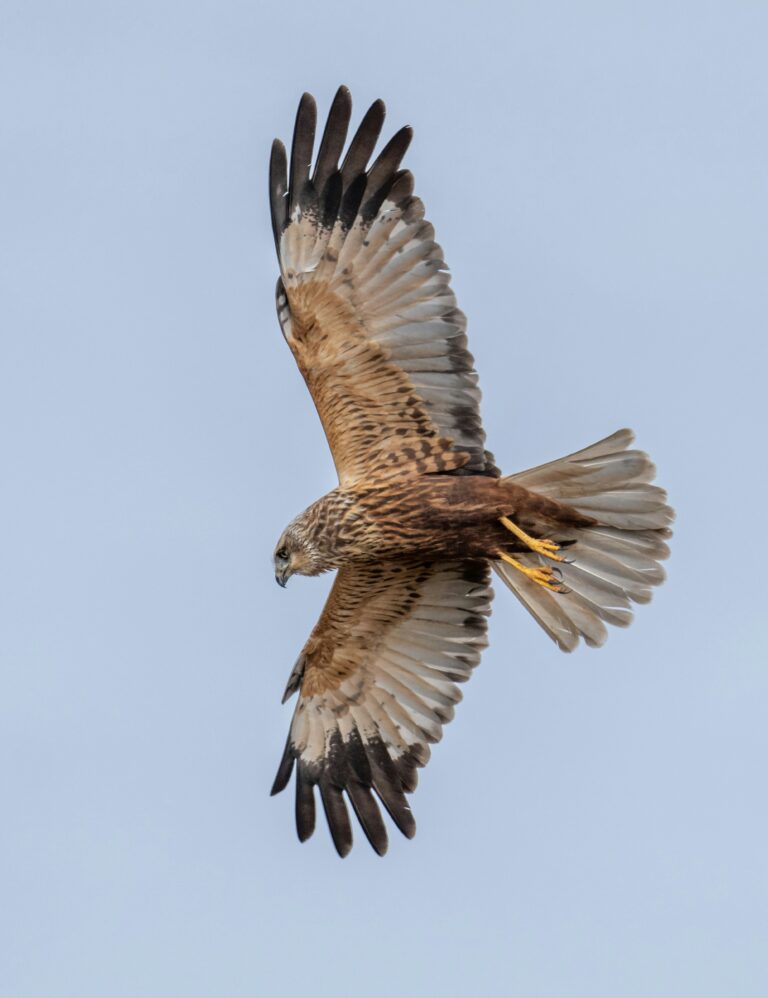
The Marsh Harrier is the harrier you are most likely to see in lowland England, especially over reedbeds. It is larger and darker.
Females are chocolate brown with a pale, creamy head, and males have a mix of brown, grey and black on the wings.
A brown harrier without a white rump over a reedbed is almost certainly a Marsh Harrier.
Hen Harrier or Montagu's Harrier?
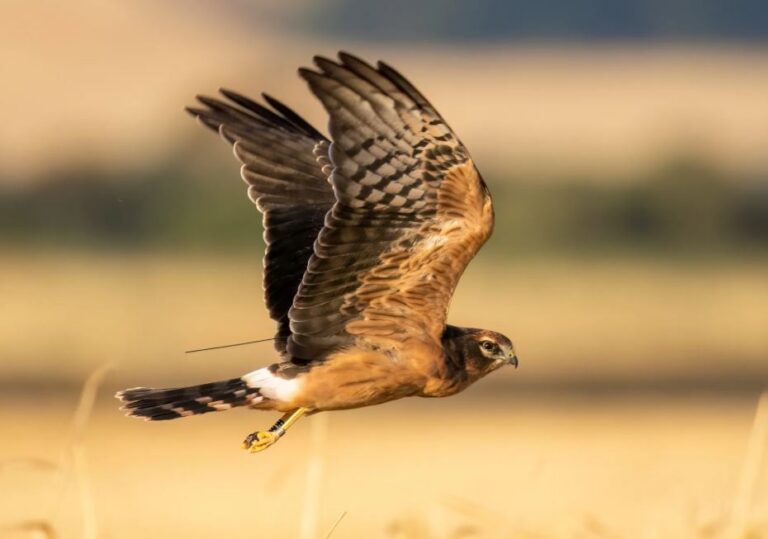
A rare third species, the Montagu’s Harrier, has recently bred in the UK again.
The Skydancer
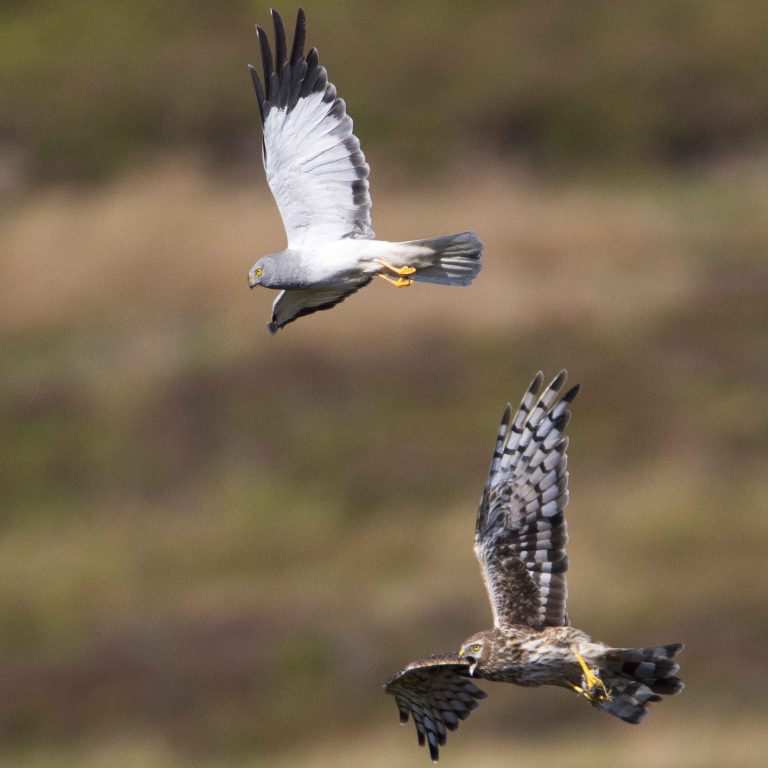
The Hen Harrier is a ground-nesting bird.
To protect the nest site, the male, which does most of the hunting while the female is incubating the eggs and chicks, passes prey in mid-air to the much less conspicuous female to return to the nest.
This has evolved into a wonderful aerial courtship display in spring, when the male climbs, tumbles and twists over the moor, giving the bird the nickname “Skydancer”.
In good years, when there is plenty of food, a male may pair with more than one female and help feed several nests. The female lays around four or five eggs, and the chicks fledge about six weeks after hatching.
The Hen Harrier's call
The Hen Harrier has a distinctive call, a rapid chattering most often heard near the nest or during display, and you are lucky indeed if you hear it.
This recording is courtesy of the Russian Academy of Sciences, with very many thanks to Olga Dmitrievna.
Where Hen Harriers live
In the breeding season, Hen Harriers in the UK are birds of upland heather moorland.
In winter some birds remain in the hills, but others move to the lowlands, including coastal marshes, farmland and heaths, where they will share communal roosts.
Satellite tagging has shown that individual birds can travel great distances, from the north of the UK into European countries such as France, Spain and the Netherlands, where they mix with other Hen Harriers.
Where to see Hen Harriers in the UK
Most of the UK’s Hen Harriers breed in Scotland, with the west Highlands, the Hebrides and Orkney holding the majority.
Islands such as Mull and Orkney are among the best places to see them in summer.
In England, the Forest of Bowland in Lancashire and the North Pennines are strongholds, and in Wales most pairs nest in the Berwyn and Migneint moors.
Winter is often the easiest time to see one. Birds spread out across the country, hunting over coastal marshes and lowland heaths, and gathering at dusk in communal roosts.
Many nature reserves with hides overlooking marsh and reedbed are good places to try.
Please watch Hen Harriers responsibly. It is against the law to disturb them at or near an active nest, so enjoy them from a distance, stick to paths, and never go looking for nests.
If you ever see something suspicious, such as a dead bird of prey, a trap or someone interfering with a nest, report it to the police on 101 and mention wildlife crime. The RSPB has more advice on reporting bird crime.
How many Hen Harriers are there in the UK?
The last national survey, carried out in 2023, found an estimated 653 territorial pairs in the UK, and 691 including the Isle of Man.
That is a welcome 20% increase on the 545 pairs found in 2016, and it halts the decline seen since 2004, when 749 pairs were recorded.
But the picture is very uneven. Scotland holds 529 pairs, 77% of the total. England had 50 pairs, up from just four in 2016, Wales had 40 and Northern Ireland only 34, a fall of around a quarter.
Scientists estimate that the UK has enough suitable habitat to support around 2,600 pairs of Hen Harriers. The Joint Nature Conservation Committee estimated that just over 21% of land in the UK is suitable for them. So even after recent gains, the population is only around a quarter of what our uplands could support. We are still missing around three quarters of our Hen Harriers.
In England alone there is enough suitable habitat for over 300 pairs of breeding Hen Harriers, but in 2025 Natural England and its partners recorded just 39 breeding attempts, 33 of which were successful, fledging 106 chicks. Hen Harriers remain largely absent from big areas of ideal habitat, including the Peak District and North York Moors. Furthermore, many of the young birds don’t even make it through their first year, let alone survive until the age of two, when they can first breed.
Where birds are left alone, they can thrive. In 2026, RSPB staff and volunteers monitoring nests on the United Utilities estate in the Forest of Bowland recorded eight successful nests out of nine, fledging 30 young, following a record year in 2025.
Hen Harriers are under threat in the UK
The Hen Harrier faces many threats. In the UK by far the largest threat is illegal persecution.
It is one of the most persecuted birds of prey in the UK, relentlessly shot and trapped on many grouse moors, despite being legally protected.
Hen Harriers were driven to extinction on mainland Britain in the nineteenth century and only began to return in the 1960s.
The RSPB’s 2026 Patterns of Persecution report, covering 2015 to 2024, recorded 49 confirmed Hen Harrier persecution incidents and a further 100 Hen Harriers that disappeared in suspicious circumstances. Around 80% of the confirmed incidents were related to gamebird shooting. You can read our summary of the report.
Hen Harriers are poisoned, shot and trapped on grouse moors
Illegal persecution on driven grouse moors has long been recognised as the main factor preventing recovery of the Hen Harrier population.
A 2019 government-commissioned study showed that 72% of satellite-tagged Hen Harriers are likely to have been illegally killed on or next to grouse moors. Hen Harriers are 10 times more likely to die or disappear in suspicious circumstances on or near a grouse moor than in any other habitat.
Hen Harriers are not even safe inside some of our National Parks, according to the study. Grouse moors in the Peak District and the North York Moors National Parks showed a strong correlation with tagged Hen Harrier disappearances. So too did Nidderdale, now a National Landscape.
A study published in 2023 in the scientific journal Biological Conservation, co-authored by our former Chair Dr Cathleen Thomas, showed that illegal killing is the main cause of death for older Hen Harriers, and that illegal killing was highest in areas managed for grouse shooting. Using data from the biggest GPS tracking study of Hen Harriers in the world, it found that tracked birds typically lived an average of just 121 days after fledging.
Prosecution is difficult, and sentences are inadequate
Hen Harriers are protected under the Wildlife and Countryside Act 1981 and killing them is against the law. Criminals who illegally kill Hen Harriers on grouse moors are difficult to catch, due to the remoteness of the locations. This makes it challenging to detect the level of crime against birds of prey. But we know that the illegal killing we have identified, mostly through expensive satellite tags, is the tip of the iceberg. And even when there is good evidence, prosecution is difficult.
In January 2026, head gamekeeper Racster Dingwall pleaded guilty to conspiring to kill a Hen Harrier on a grouse moor in the Yorkshire Dales National Park, after being caught on covert RSPB film. It was the first conviction of its kind in England. He was ordered to pay £1,520 in fines and costs.
Even when a case reaches court, the available sentences are low. In England and Wales, killing a Hen Harrier can result in an unlimited fine or up to six months in jail. Scotland raised its maximum penalty for the most serious wildlife crimes to five years in prison in 2020.
How Hen Harrier Action helps
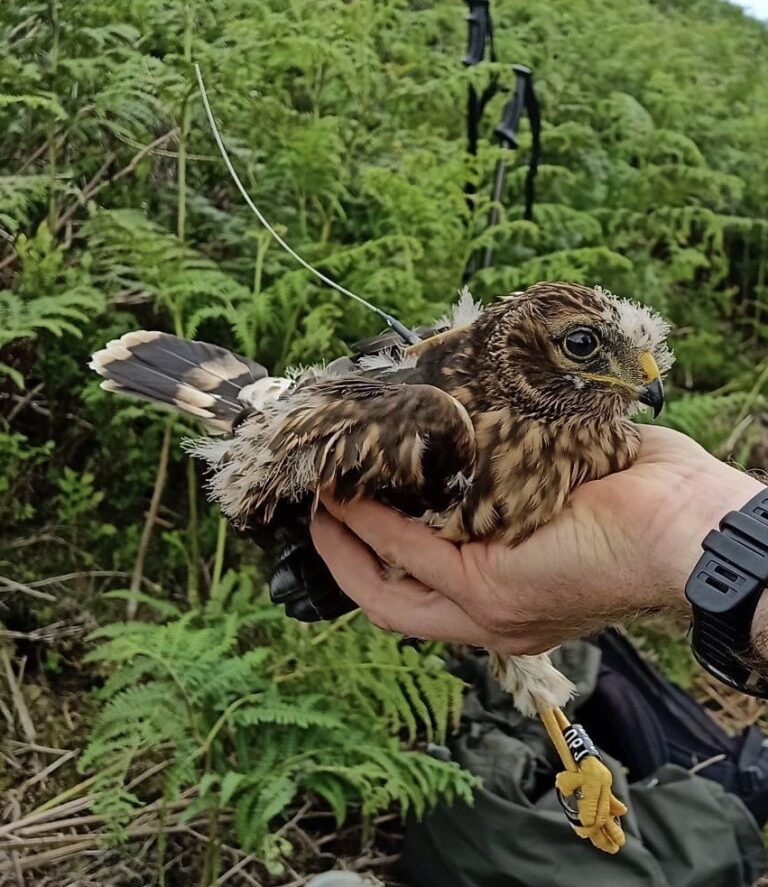
Each year Hen Harrier Action funds satellite tags that are fitted to young Hen Harriers in the UK during the summer by licensed RSPB taggers and local raptor study groups.
The tags help to monitor the birds and protect them, because a tagged bird is harder to kill without anyone noticing. Dr Cathleen Thomas, our former Chair, coordinated the largest tagging programme for Hen Harriers in Europe while she was leading the RSPB’s Hen Harrier LIFE project, and told us a little bit about how it all works.
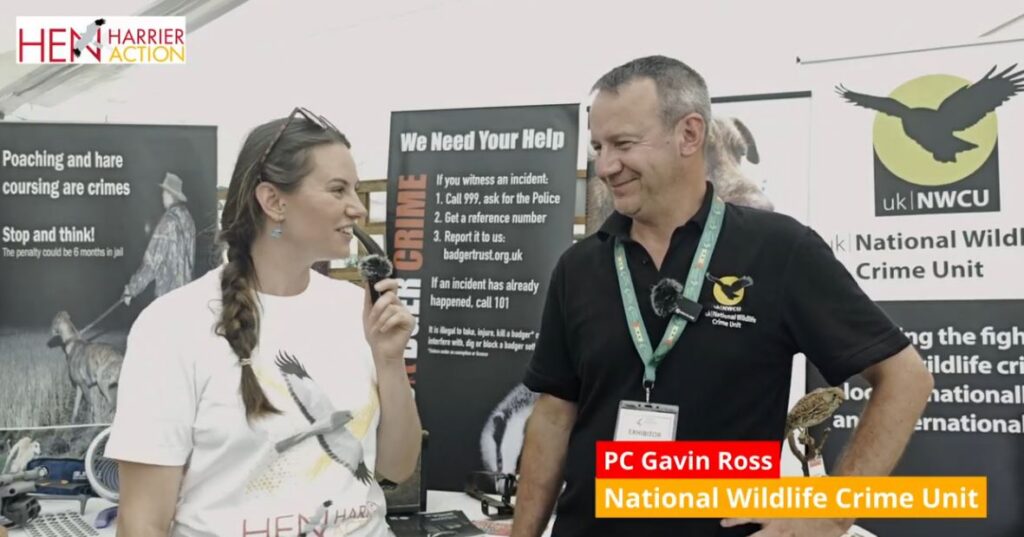
We have also raised money to train and deploy wildlife crime detection dogs, working closely with the National Wildlife Crime Unit.
Join a Hen Harrier Day event and show your support!
There is much to be done to tell the stories of our birds, and Hen Harrier Day events seek to contribute by adding to public and media awareness in the days immediately before the “Inglorious” 12 August, the start of the grouse shooting season.
Find out how you could run a Hen Harrier Day event and show your support.
Stay in touch. Sign up to our newsletter for news about our tagged birds, events and how you can help Hen Harriers.
Frequently asked questions
How rare are Hen Harriers in the UK?
Very rare. The 2023 national survey found around 653 territorial pairs in the UK, only about a quarter of the number our uplands could support. They are red-listed as a Bird of Conservation Concern, mainly because of illegal persecution.
How many Hen Harriers are left in the UK?
An estimated 653 pairs in 2023, most of them in Scotland. England had around 50 pairs that year, and 39 breeding attempts in 2025.
Is a Hen Harrier bigger than a Buzzard?
No. They are a similar length, but a Buzzard is much bulkier, with broader wings, and can weigh twice as much. Hen Harriers are slimmer, with longer tails, and hunt low over the ground.
How do I identify a Hen Harrier?
Look for a slim bird of prey flying low over open ground with its wings held in a shallow “V”. Males are pale grey with black wingtips. Females and young birds are brown with a white rump and a banded tail.
What is the difference between a male and female Hen Harrier?
Males are pale grey and white with black wingtips. Females are larger and brown, with streaked underparts, a white rump and a banded tail, which gives them the nickname “ringtail”.
Why is it called a Hen Harrier?
The name comes from its old habit of taking free-range chickens, or hens, back when poultry was kept loose around farms.
Where can I see a Hen Harrier?
In summer, the upland moors of Scotland, especially the Hebrides, Mull and Orkney, and the Forest of Bowland in England. In winter, look over coastal marshes and lowland heaths, especially near dusk when birds gather to roost.